This afternoon, I donned a hat and went outside to weed my garden beds. A much younger me had put in a too-big-for-me-now garden bed at the back side of the swimming pool. Weeding each spring is a monumental task.
On a normal year, I'd weed like a maniac. My goal was to get it done as fast as I could so I could get to other tasks that also needed done. But this year, I'm retired. And I'm learning that things that once were urgent are not so anymore. I can weed today and tomorrow and next week if I choose.
I took up my hand rake and garden gloves and trash bag and sat on the back of the retaining wall. The sun had warmed the blocks comfortably enough that I could have sat there all day just to warm my bum. I raked and dug and pulled the weeds that had grown nearly knee high after a week of rains. I'd learned long ago that the best time to weed is a few days after rains had loosened the soil, but the sun had dried it just enough to keep it from being muddy. Today, the soil was perfect. Damp and cool and easy to turn.
As I worked the soil gently in my fingers, kneading old mulch and dried leaves deep into the bed where nutrients of old can nurture new plants, my mind became engrossed in the wonders of our Earth -- the simple sights and gentle sounds of nature that soothe my soul. The robins twittering in the massive oak trees above me. The starlings drinking from the remnants of rain puddles in the pool cover. The katydid disturbed by my hand chittering as it flew to find new shelter in a shrub. The ants scurrying to hide their uncovered eggs. A lone earthworm reburied. The wind in the leaves. The sun on my skin. The dirt on my hands. And shirt. I could relish this task this year. And find joy in the things I see and the things I can hear because of my hearing instruments.
I'm not even close to being done. There's much left to finish, my older self sighs, knowing there's more to treasure in this calmer life I am making for myself.
I can work. I can while. The decision is mine.
Tuesday, April 17, 2018

Tuesday, March 20, 2018
Checkups and Ice Cream and Stuff
It's not that I've been neglecting this blog, but oftentimes life just plugs along in an uneventful litany of days and weeks and months. You sleep. You rise. You eat. You wash the laundry. You pet the dog. Notoriously boring stuff to blog about.
Then you visit your otologist for your yearly checkup.
Living with hearing loss, and the potential of future losses, the annual audiogram and doctor visit is the reminder of how easily something you have can be suddenly lost. Again.
"So, tell me how you're doing?" he begins.
"I'm good," I reply. "How 'bout that audiogram?"
"It's stable," he says. I already knew that. My audiologist already told me so. Then he goes on about missing the Meniere's conference this year as he checks my ears.
I inject that the coil on my CI has been giving me headaches and that the coil spacer the audiologist gave me has only made it slightly better. He checks my scalp for bumps and sores. He checks my mandibular joint for TMJ, and taps on the occipital nerve for soreness. Finding none, he tells me I should turn the coil magnet out as far as it will go.
"I've done that already," I tell him. He turns it anyway. Then he tells me a story about how watching my salt intake will reduce my risk of losing more hearing in my better ear and quotes some kind of research he learned about at the Meniere's conference last year. I think he's deflecting.
"I bought a cabin in Colorado and plan to move in a year or so. I'm looking for a CI clinic there," I tell him. He asks where and tells me I should go to a clinic in Denver where Cochlear has their headquarters. It's too far, so he recommends a CI doctor a few hours closer.
"You are doing really well with your CI," he says, inspecting my audiogram carefully. "One of my best successes."
"I complain a lot about the quality of the sound," I say, "but I know I'm really successful with it."
"I want to see you again in 6 months," he says.
"Not a year this time?" I ask.
"I want to see if turning the magnet out helps the headache," he says. I remind him that I've already tried that. "You could try a Tylenol," he advises.
Then I ask for a copy of my audiogram and leave.
I inspect my new audiogram and compare it with a past one from 4 years ago, after my sudden hearing loss episodes stabilized. I've saved photos of each report in my phone. I find that most of the levels are indeed stable, only moving down by 10dB in most of the frequencies, ranging from mild loss in the low frequencies to severe loss in the mid to high frequencies. What I didn't expect was the change in the presentation level of the word test. The previous audiogram presented words at 60dB. I scored 100% word recognition on the new audiogram but the volume now presented at 85dB. An indication that though my pure tones are somewhat stable, I now need much more volume to understand words.
It is the first time I have seen my CI results printed on the record sheet. My tones test was straight across at 30 dB, with the words "near full CI access" written across the grid. My words test was 88% at a presentation level of 65dB. I remember missing one word completely when I thought my audi said, "n'glif" and just shook my head. I don't know why missing words still embarrasses me. Understanding words without context is hard. I can clearly see from this audiogram how I can hear better with my CI than my other ear when unaided.
These visits always leave me a little depressed. This one was no different. Hearing loss really sucks.
But I heard a mother tell her young son at the appointment desk how proud she was of him for playing the games so well with the audiologist and she asked him if he wanted to get an ice cream on the way home. Yes. Ice cream. I would treat myself, too.
It was a cup of low-fat chocolate peanut butter cup yogurt with brownie sprinkles. And it made me feel a lot better emotionally. But my head still hurts.
Then you visit your otologist for your yearly checkup.
Living with hearing loss, and the potential of future losses, the annual audiogram and doctor visit is the reminder of how easily something you have can be suddenly lost. Again.
"So, tell me how you're doing?" he begins.
"I'm good," I reply. "How 'bout that audiogram?"
"It's stable," he says. I already knew that. My audiologist already told me so. Then he goes on about missing the Meniere's conference this year as he checks my ears.
I inject that the coil on my CI has been giving me headaches and that the coil spacer the audiologist gave me has only made it slightly better. He checks my scalp for bumps and sores. He checks my mandibular joint for TMJ, and taps on the occipital nerve for soreness. Finding none, he tells me I should turn the coil magnet out as far as it will go.
"I've done that already," I tell him. He turns it anyway. Then he tells me a story about how watching my salt intake will reduce my risk of losing more hearing in my better ear and quotes some kind of research he learned about at the Meniere's conference last year. I think he's deflecting.
"I bought a cabin in Colorado and plan to move in a year or so. I'm looking for a CI clinic there," I tell him. He asks where and tells me I should go to a clinic in Denver where Cochlear has their headquarters. It's too far, so he recommends a CI doctor a few hours closer.
"You are doing really well with your CI," he says, inspecting my audiogram carefully. "One of my best successes."
"I complain a lot about the quality of the sound," I say, "but I know I'm really successful with it."
"I want to see you again in 6 months," he says.
"Not a year this time?" I ask.
"I want to see if turning the magnet out helps the headache," he says. I remind him that I've already tried that. "You could try a Tylenol," he advises.
Then I ask for a copy of my audiogram and leave.
I inspect my new audiogram and compare it with a past one from 4 years ago, after my sudden hearing loss episodes stabilized. I've saved photos of each report in my phone. I find that most of the levels are indeed stable, only moving down by 10dB in most of the frequencies, ranging from mild loss in the low frequencies to severe loss in the mid to high frequencies. What I didn't expect was the change in the presentation level of the word test. The previous audiogram presented words at 60dB. I scored 100% word recognition on the new audiogram but the volume now presented at 85dB. An indication that though my pure tones are somewhat stable, I now need much more volume to understand words.
It is the first time I have seen my CI results printed on the record sheet. My tones test was straight across at 30 dB, with the words "near full CI access" written across the grid. My words test was 88% at a presentation level of 65dB. I remember missing one word completely when I thought my audi said, "n'glif" and just shook my head. I don't know why missing words still embarrasses me. Understanding words without context is hard. I can clearly see from this audiogram how I can hear better with my CI than my other ear when unaided.
These visits always leave me a little depressed. This one was no different. Hearing loss really sucks.
But I heard a mother tell her young son at the appointment desk how proud she was of him for playing the games so well with the audiologist and she asked him if he wanted to get an ice cream on the way home. Yes. Ice cream. I would treat myself, too.
It was a cup of low-fat chocolate peanut butter cup yogurt with brownie sprinkles. And it made me feel a lot better emotionally. But my head still hurts.
Saturday, December 30, 2017
Don't Read the Comments
Social media. Gaaaahhhhh.
I say it all the time: "Don't read the comments. Don't read the comments. Don't read the comments."
Then what do I do? I read the comments.
I also tell myself to ignore posts I know are click bait and move on. "Don't comment. Don't comment. Don't comment."
Then what do I do? I make a comment.
I'm bad like that. (You are, too. Admit it.)
Social media can be fun and amazing. And awfully aggravating. The ignorance displayed and shared in well-meaning or not-so-well-mearning comments is incredible.
Take one of those well-meaning social media groups where people with cochlear implants can ask questions and hear about other's experiences. I've learned a lot about my CI from them.
And then -- there are the people chiming in with their opinions, half-knowledge, or bits of "I heard..." or "I read..." and exhorting them as fact. There's usually one or two overlooked comments advising people to call their audi, but more often than no,t there are bunches of comments offering all kinds of absolute advice. And then there's you --knowing that your doctors and/or audiologists have completely advised you MUCH differently. Don't comment. Don't comment... DON'T COMMENT.
But you do. And your notifications blow up.
I've asked my audiologists about some of the posts and comments on the page. They chuckle most of the time and advise me to call them if I need help. They have doctorates, after all, and decades of experience treating patients with cochlear implants.
The convenience of seeking help online seems to be replacing our willingness to ask the ones who are educated to know how to help us -- our medical experts.
The fact is that having a cochlear implant doesn't make one a medical expert on cochlear implants. And one cochlear implant experience may be completely different from another. There's a fine line between sharing our experience and touting our own medical expertise. We should be careful not to cross it. Telling another recipient that their symptoms and/or problems can or cannot be caused by their implant may prevent them from seeking the medical help from the experts that can resolve their problems, anxiety, or needs.
It's probably time for me to leave that group.
I say it all the time: "Don't read the comments. Don't read the comments. Don't read the comments."
Then what do I do? I read the comments.
I also tell myself to ignore posts I know are click bait and move on. "Don't comment. Don't comment. Don't comment."
Then what do I do? I make a comment.
I'm bad like that. (You are, too. Admit it.)
Social media can be fun and amazing. And awfully aggravating. The ignorance displayed and shared in well-meaning or not-so-well-mearning comments is incredible.
Take one of those well-meaning social media groups where people with cochlear implants can ask questions and hear about other's experiences. I've learned a lot about my CI from them.
And then -- there are the people chiming in with their opinions, half-knowledge, or bits of "I heard..." or "I read..." and exhorting them as fact. There's usually one or two overlooked comments advising people to call their audi, but more often than no,t there are bunches of comments offering all kinds of absolute advice. And then there's you --knowing that your doctors and/or audiologists have completely advised you MUCH differently. Don't comment. Don't comment... DON'T COMMENT.
But you do. And your notifications blow up.
I've asked my audiologists about some of the posts and comments on the page. They chuckle most of the time and advise me to call them if I need help. They have doctorates, after all, and decades of experience treating patients with cochlear implants.
The convenience of seeking help online seems to be replacing our willingness to ask the ones who are educated to know how to help us -- our medical experts.
The fact is that having a cochlear implant doesn't make one a medical expert on cochlear implants. And one cochlear implant experience may be completely different from another. There's a fine line between sharing our experience and touting our own medical expertise. We should be careful not to cross it. Telling another recipient that their symptoms and/or problems can or cannot be caused by their implant may prevent them from seeking the medical help from the experts that can resolve their problems, anxiety, or needs.
It's probably time for me to leave that group.
Wednesday, December 13, 2017
One Person
I've often heard that it takes one person to affect change. One. One person. One person to speak out. To begin a thought. A feeling. An action. One person to change an opinion. A mindset. One person to make a difference.
I find myself advocating for the deaf and hard of hearing often. Sometimes reminding people to consider others' differences and disabilities. Sometimes asking for patience and understanding. Sometimes correcting misunderstanding or misinformation. And just telling my story. I've had opportunities in face-to-face interactions and in this blog. Most, however, occur on social media.
Social media is a great place for sharing stories and life anecdotes. A place to laugh; sometimes to cry. Unfortunately, it is wrought with insensitive memes, quotes, and comments from people who just don't consider who may be hurt or offended. I'm sure I've been guilty of that, too.
 Today, I was struck by such a meme -- one I chose to comment on both of the occasions that it crossed my news feed because it hits so close to home. The meme simply asked how many times one needed to say 'excuse me' to a person before they shouted 'get the hell out of my way.' It's not the meme that bothers me so much, but the mindset that spurred it.
I was astonished at the impertinence of those who commented under the posts, with numerical answers ranging from once is enough to suggesting that ramming the person with their shopping cart was acceptable. People who surely thought they were being amusing. I hope.
I could have scrolled past and ignored it, as I often do. Instead, I decided to comment on both posts that it was never acceptable to do that, not just because it's hateful, but because the person may be deaf or hard-of hearing and might not have heard them. I know it's happened to me many times. I'm only aware of those times because my daughters happened to be with me and nudged me out of the way. I'm certain it happens a lot when I'm alone, too.
The truth is that you don't know if the person is just being rude or if they simply cannot hear you. The presumption that the person is being rude and deserves a crude response is both uncivil and inappropriate. And insensitive. And people need to know that.
Living with hearing loss is no easy task in a world that takes hearing for granted. To presume that others can hear as well as another is an attitude that I hope to correct and change. One person at a time. One comment at a time.
Unfortunately, both of the posts appeared to be taken down after I commented, so my message was lost. Perhaps out of respect for me. Or embarrassment. Or because these friends have a new understanding. Whatever the reason, it is for the good. Two friends will think differently the next time someone doesn't move when they've been asked.
Invisible disabilities are real and prevalent. It's never okay to forget that. We can't assume the motives of others because we don't know why they act the way they do. And we shouldn't be rude because of that ignorance. We should consider the circumstances of others before we react. We should be kinder to one another.
That's what I hope we all learn.
I find myself advocating for the deaf and hard of hearing often. Sometimes reminding people to consider others' differences and disabilities. Sometimes asking for patience and understanding. Sometimes correcting misunderstanding or misinformation. And just telling my story. I've had opportunities in face-to-face interactions and in this blog. Most, however, occur on social media.
Social media is a great place for sharing stories and life anecdotes. A place to laugh; sometimes to cry. Unfortunately, it is wrought with insensitive memes, quotes, and comments from people who just don't consider who may be hurt or offended. I'm sure I've been guilty of that, too.
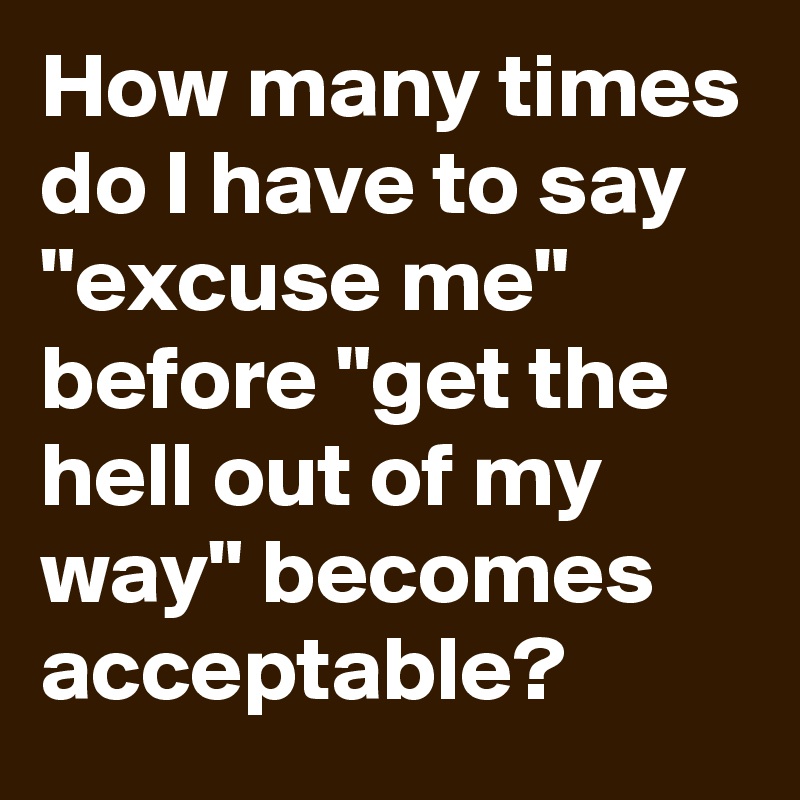 Today, I was struck by such a meme -- one I chose to comment on both of the occasions that it crossed my news feed because it hits so close to home. The meme simply asked how many times one needed to say 'excuse me' to a person before they shouted 'get the hell out of my way.' It's not the meme that bothers me so much, but the mindset that spurred it.
I was astonished at the impertinence of those who commented under the posts, with numerical answers ranging from once is enough to suggesting that ramming the person with their shopping cart was acceptable. People who surely thought they were being amusing. I hope.
I could have scrolled past and ignored it, as I often do. Instead, I decided to comment on both posts that it was never acceptable to do that, not just because it's hateful, but because the person may be deaf or hard-of hearing and might not have heard them. I know it's happened to me many times. I'm only aware of those times because my daughters happened to be with me and nudged me out of the way. I'm certain it happens a lot when I'm alone, too.
The truth is that you don't know if the person is just being rude or if they simply cannot hear you. The presumption that the person is being rude and deserves a crude response is both uncivil and inappropriate. And insensitive. And people need to know that.
Living with hearing loss is no easy task in a world that takes hearing for granted. To presume that others can hear as well as another is an attitude that I hope to correct and change. One person at a time. One comment at a time.
Unfortunately, both of the posts appeared to be taken down after I commented, so my message was lost. Perhaps out of respect for me. Or embarrassment. Or because these friends have a new understanding. Whatever the reason, it is for the good. Two friends will think differently the next time someone doesn't move when they've been asked.
Invisible disabilities are real and prevalent. It's never okay to forget that. We can't assume the motives of others because we don't know why they act the way they do. And we shouldn't be rude because of that ignorance. We should consider the circumstances of others before we react. We should be kinder to one another.
That's what I hope we all learn.
Tuesday, November 21, 2017
Coffee Sign
As I was running errands this morning, I stopped for a coffee at the local Quik Trip. Without even thinking about it, I signed "thank you" to the young man who made my skinny vanilla latte. To my surprise, he signed back. I've no idea what he signed, so I smiled my doofus smile and nodded, grabbed my coffee, and made a quick exit.
 |
| Coffee |
Shortly after I got my cochlear implant, I took a beginning sign language class given by a friend of mine. Learning sign language isn't much different cognitively than learning any language. You have to use and practice it often or you'll forget. Having no one to practice with, I forgot much of the things I learned shortly after the class ended. I used the ASL alphabet in my classroom with my students, finger spelling sight words for spelling practice. I also used a few other signs with them to cut down the noise in my room -- notably the help, restroom, and thank you signs. Those I remember, but other words come slower -- if anyone is willing to wait while I attempt to communicate letter by letter.
I rarely see signing being used in public. Once at a restaurant and another time at the mall. And today by the young latte maker. My daughter is quick to elbow me when we are out together and point out signers when she sees them, as if I am a part of their secret club.
But I'm not much like them at all. We are both deaf, yes. But I don't know their language. And spelling all my words would be woefully tedious for both of us.
My tradition is oral and hearing. I am a hearing person who cannot hear. I have a foot in both worlds.
I wonder how the young man came to sign. Did he learn it because a family member or friend is deaf? Or did he just want to learn it as a second language?
I'll never know because I nearly ran myself over exiting the place. Next time I'll be more prepared.
Wednesday, November 1, 2017
It's Just Not True
I have been asked to speak to a college class of student speech-language pathologists again this year. It has again set my mind thinking about what I can tell these future professionals who will most certainly be working with children and adults who have hearing aids and cochlear implants. I'd like to tell them that the CI is a miracle in hearing technology. I'd like to tell them that hearing with a CI is an amazing experience. But it's just not true.
Sometimes I've been asked by friends to talk to people who are considering implantation. People who want to talk to someone with a CI and ask questions of someone with real-life experience -- not just a hearing doctor or audiologist who's told them they need a CI. Even though implantation is becoming more common, it's still a relatively rare thing, and most people don't know anyone with one. Talking to someone who's gone through it is comforting. I remember how scary and frustrating it was for me. I don't mind doing that. It's always a little weird at first because I'm not like a lot of recipients who sing the praises of the cochlear implant. It just hasn't been as marvelous for me as it seems to be for others. But the people I've met have been appreciative of my candor.
My hard-of-hearing life has become mundanely routine. It begins each morning with me reaching for my hearing aid. I cannot hear well enough without it to function well, so after my eyeglasses, my hearing aid is the 2nd thing I don. But the CI processor often sits in the Zephyr dryer unless I need to go somewhere or hear well while I'm in the house. Like when the hearing hubs wants to have a conversation without me asking him to repeat himself repeatedly. The truth is that I really do hear better with both devices. But it's hardly comfortable, often causing the skin under the magnet to ache, and occasionally leading to headaches, so unless it's necessary for me to hear well, it sits in the dryer until I need it. On days that I do wear it all day, there is a moment each evening where I just can't stand it any longer and I have to take it off.
And all those accessories that go with it? They sit in a box, too. I occasionally charge the remote so I can change my volume if I'm going into an unknown hearing setting. Just in case. But it usually just sits in my purse until the charge runs out and I return it to it's storage box, too. When I use accessories, it's to stream the sound to my hearing aid, not my CI. I hear MUCH better with my hearing aid than my CI.
I'd like to say that after four years with my cochlear implant, that my hearing is so much better now. But I honestly can't say that the quality of sound I perceive is any better than when I first began. I've just gotten used to it. It's still as tinny and mechanical as it's ever been. I don't hold any false hopes that it will improve with listening practice because I've been listening for four years. I still struggle with comprehension. Closed captioning has become a necessity when I watch TV, even when I stream the sound to my hearing aid. Actors have terrible enunciation. They aren't the only ones either. It's difficult to understand a lot of people because of poor and/or lazy speaking habits that blur sounds and words. And there are no closed captions to read during live conversation! I still miss a lot. I have anxiety that if I lose my other ear, the CI won't be sufficient for me to hear or understand well at all.
Cochlear implants are often touted by hearing professionals and recipients as miracle devices full of wonder and awe. It's just not true. It will help you hear. But it will be limited by your own physiology and by it's technological parameters. The struggle is real. And it's continual. And it's exhausting.
This is what you should know.
Sometimes I've been asked by friends to talk to people who are considering implantation. People who want to talk to someone with a CI and ask questions of someone with real-life experience -- not just a hearing doctor or audiologist who's told them they need a CI. Even though implantation is becoming more common, it's still a relatively rare thing, and most people don't know anyone with one. Talking to someone who's gone through it is comforting. I remember how scary and frustrating it was for me. I don't mind doing that. It's always a little weird at first because I'm not like a lot of recipients who sing the praises of the cochlear implant. It just hasn't been as marvelous for me as it seems to be for others. But the people I've met have been appreciative of my candor.
My hard-of-hearing life has become mundanely routine. It begins each morning with me reaching for my hearing aid. I cannot hear well enough without it to function well, so after my eyeglasses, my hearing aid is the 2nd thing I don. But the CI processor often sits in the Zephyr dryer unless I need to go somewhere or hear well while I'm in the house. Like when the hearing hubs wants to have a conversation without me asking him to repeat himself repeatedly. The truth is that I really do hear better with both devices. But it's hardly comfortable, often causing the skin under the magnet to ache, and occasionally leading to headaches, so unless it's necessary for me to hear well, it sits in the dryer until I need it. On days that I do wear it all day, there is a moment each evening where I just can't stand it any longer and I have to take it off.
And all those accessories that go with it? They sit in a box, too. I occasionally charge the remote so I can change my volume if I'm going into an unknown hearing setting. Just in case. But it usually just sits in my purse until the charge runs out and I return it to it's storage box, too. When I use accessories, it's to stream the sound to my hearing aid, not my CI. I hear MUCH better with my hearing aid than my CI.
I'd like to say that after four years with my cochlear implant, that my hearing is so much better now. But I honestly can't say that the quality of sound I perceive is any better than when I first began. I've just gotten used to it. It's still as tinny and mechanical as it's ever been. I don't hold any false hopes that it will improve with listening practice because I've been listening for four years. I still struggle with comprehension. Closed captioning has become a necessity when I watch TV, even when I stream the sound to my hearing aid. Actors have terrible enunciation. They aren't the only ones either. It's difficult to understand a lot of people because of poor and/or lazy speaking habits that blur sounds and words. And there are no closed captions to read during live conversation! I still miss a lot. I have anxiety that if I lose my other ear, the CI won't be sufficient for me to hear or understand well at all.
Cochlear implants are often touted by hearing professionals and recipients as miracle devices full of wonder and awe. It's just not true. It will help you hear. But it will be limited by your own physiology and by it's technological parameters. The struggle is real. And it's continual. And it's exhausting.
This is what you should know.
Saturday, August 26, 2017
I Didn't Forget
August 14 came and went again this year.
I didn't forget that it was the anniversary of my sudden hearing loss.
I didn't forget to make a blog post marking the day that thrust me into muffled silence.
I didn't forget the moment my life changed forever.
I didn't forget the audiogram that determined my level of sound perception in my damaged cochlea.
I didn't forget the doctor's words when he told me my hearing loss was profound. And permanent.
I didn't forget the feeling of panic as I drove home. Fearing the impact deafness would make on my life. The desperation. And the dread.
I didn't forget the confusion and frustration as I tried to come to grips with a life where I couldn't understand conversation, television, radio, or take a simple phone call.
I didn't forget the challenges of learning about speech bananas, audiograms, decibels, hearing aids, batteries, dome tips, volume, wind noise, static, reverberation, feedback, vibrating alarms, strobe notifications, FM assistive listening devices, euro adapters, amplification, closed captioning, hearing impaired settings, ADA, and ear wax. Or cochlear implants.
I didn't forget the missed conversations, the "whats?", and the "never minds."
I didn't forget appointments for CTs and MRIs and balance tests and audiograms and evaluations.
I didn't forget the misunderstanding, impatience, and cruel words of coworkers and administrators - spoken behind my back, but revealed to me by true friends -- as I struggled to cope and adapt.
I didn't forget the friends and family who offered support and empathy -- who lent an ear, directed me to places for help, cried along with me as I grieved.
I didn't forget the doctors and audiologists who expertly and patiently eased me into hearing aids, assistive listening devices, and cochlear implant programs that help me make the best of an imperfect situation.
I didn't forget the ones who repeat their words over and over, make the effort to speak clearly when addressing me, or clip my microphone to their shirt so that I am included in their conversations. And their lives.
I didn't forget the children whose hearing loss I noticed -- and helped. Likely more aware because of my own hearing loss.
I didn't forget the people I've friended who've experienced sudden hearing loss, as well, and the encouraging word I can now offer to them because I know what it's like.
I didn't forget the resilience that hearing loss would force upon me. From utter devastation to coping to surviving to encouraging. To living.
I didn't forget.
Subscribe to:
Posts (Atom)