To a hearing person, the loss of sound is frightening. Panic worthy. As much as my cochlear implant and hearing aid help, there are times that wearing them is painful to my ear canal and head and I need small breaks without them to recover. Having "impaired" but viable hearing in one ear helps during these times. I can navigate the ins and outs of my day at home alone with only the residual hearing I have in my better ear.
I have longed feared that another sudden sensorineural hearing loss would rob me of what's left, even though my audiograms of that ear have remained relatively stable for several years now. I rely on that ear for better speech comprehension, media streaming, and music. My CI "helps" me hear, but it isn't really good enough for me to comfortably make it in my hearing environment alone.
Last week while spending a week at our Colorado cabin, I noticed my ear popping and equalizing the pressure as normal, but it was affecting the clarity with which I could hear, and there was an annoying ache deeper inside than I could explain. I could tell that my ears were compensating and I was hearing more from the CI processor than my hearing aid. I avoided playing a game with the family since I knew I was having trouble hearing. It was only after I retired to my bed to read some and I took off my hearing devices to experience the full impact of the dread I have always feared. Complete and utter silence. I could not even hear my own voice.
Panicked, I hastened my husband upstairs and he brought along my daughter, a physician's assistant in an ENT specialty. Without her instruments, she could only try to reassure me that with the earache, it was likely an infection or eustachian tube disfunction. I was lucky to get an appointment the next morning with a nurse practitioner at the local clinic in an adjacent town. Expecting that this small town clinic would have no experiences with sudden sensorineural hearing loss, my daughter came with me and examined my ear to find a retracted eardrum. Even when I "popped" my ear, it remained retracted and all sound above a slight vibration and buzz was gone. She suspected that it was a conductive loss because of the retraction, but given my history, she couldn't be sure. The only course of treatment was to receive a high-dose course of steroids once again, which is the prescribed treatment for both conductive and sensorineural hearing loss. She consulted with the nurse practitioner about the proper dose. Meds were prescribed and we were on our way.
4 days later, I have hearing in that ear again. Not as much as before, I can tell, but enough that my panic has subsided. I will see my otologist in 3 days for an audiogram. That will provide more insight into just what occurred last week. I am confident that I have not completely lost this ear, but I will most likely need a hearing aid adjustment to compensate for the event.
What surprised me through this time is how reliant I had become on my better ear and using only my hearing aid for my day-to-day tasks. I honestly don't like the CI and I don't wear it unless I will be in hearing environments that warrant better hearing. What I found out is that while my other ear has been recovering, my CI is better than I'd thought. I've done ok with it alone, if not as good as both ears.
For now, I have 6 more days of Prednisone treatment working to stop the attack on my ears and hearing. And I have a CI that I must don from sunup to bedtime now if I am to hear well enough to get through the day. I do not embrace this deafness willingly or graciously. It is the lot I've been dealt. And all I can do is deal with it.
I will keep you updated when I know more.
Monday, October 21, 2019

Monday, January 21, 2019
I Wish You Deafness
My wish for you is deafness if only for a day. Hard-of-hearing, impaired, disabled, whatever it's called. Then maybe you'd understand.
I wish for you a deafness. Silence or muffled. It really doesn't matter. I wish for you the struggle I face every single day.
I wish for you a hearing aid. A cochlear implant. A bone-anchored hearing device. I wish for you the tinny, squeaky amplification of I-can-almost-hear-it-but-I've-no-idea-what-it-is. I wish for you technology that's imperfect at its best. I wish for you the scars and pain of things inside your head.
I wish for you the squealing feedback when people give you a hug. I wish for you the dying batteries in the middle of a conversation or a movie or lecture. I wish for you the continual adjustments to make your aids "just right" and the feelings of disappointment when they most often fall short.
I wish for you the extra packs of batteries. The chargers and the cords. The handheld devices that fill your pockets and purse. I wish for you the streamers and mics and FM devices and remotes. I wish for you a theater that actually has been looped so the telecoil in your aids might actually be put to use. I wish for you closed captioning that actually reads like the script. No misspellings, no missed words, and synchs with the actors' lips.
I wish for you the cost of buying and maintaining and repairing and upgrading your devices, and the insurance to cover the bulk. The audiology and surgeon appointments. The dreadful sound booth and beeps you may or may not hear. I wish for you those days you hate when you're told you're doing well. But deep inside you know it's fake. So you smile and walk away.
I wish for you the scaly ear canals from wearing a mold all day. I wish for you the floppy ear and little red sores behind you ear where your processor rubs away. I wish for you the wig tape to hold little things in place. The retainers, the ear hooks, the mic locks. I wish for you the ear wax that clogs your mold and mics. The wax guards and mic protectors and ear gear to keep the gunk at bay. I wish for you the magnet that often leaps away - to the umbrella, the car door, the costume jewelry of your friend while giving a hug, or simply falls to the ground.
I wish for you the exhaustion of trying so hard to hear. The missed conversations when your brain is too tired. I wish for you to ask others to repeat again and again, knowing you may never understand. I wish for you tenacity so that you may never give up.
I wish for you the noisy restaurants, the too-loud background music, the loud conversations at the table across for you. The laughing, the crunching, the dishes clanking, the order taking, the babies crying. I wish for you that earnest desire to decipher the words and understand your dinner companion among the clamorous noise.
I wish for you the rolled eyes and sighs and oh-my-goshes. The it's not that important or forget it when you struggle to hear. The you never listen and pay attention and are you wearing your hearing aid today? You're being ridiculous. You're stronger than that. Quit moping. Get up and join the game. I wish for you that last nevermind that always makes you cry.
I wish for you the chuckles of friends who laugh at your expense. Time and again you ask, "Did you say Amanda or banana or sandwich?" I wish for you those who answer questions directed at you before you get the chance. I wish for you those people who think that you are being rude. Who think that if you'd just paid attention, you'd know just what to do.
I wish for you the mumblers and those who don't speak up. I wish for you the accents and poor enunciation and those who chew gum and eat while talking to you. I wish for you the shaggy beards that hide the lips you read. I wish for you the ones who shout from other rooms or talk as they walk away. I wish for you those who bemoan why you didn't hear. If only you'd been a better listener, you'd know what they had said.
I wish for you understanding. To know how hard it can be. I wish for you patience when I'm slower to respond, or answer, or contribute. I wish you just knew it takes time to hear and understand you.
There's so much more I could wish for you if you were deaf for a day. But most of all, I'd wish for you a world that is kinder than the one that we have now. I'd wish for a place where empathy and lenience and compassion for others' differences were not only evident, but demonstrated without thought, even for those like me. Deaf, hearing, or somewhere in between.
That is my wish for you.
I wish for you a deafness. Silence or muffled. It really doesn't matter. I wish for you the struggle I face every single day.
I wish for you a hearing aid. A cochlear implant. A bone-anchored hearing device. I wish for you the tinny, squeaky amplification of I-can-almost-hear-it-but-I've-no-idea-what-it-is. I wish for you technology that's imperfect at its best. I wish for you the scars and pain of things inside your head.
I wish for you the squealing feedback when people give you a hug. I wish for you the dying batteries in the middle of a conversation or a movie or lecture. I wish for you the continual adjustments to make your aids "just right" and the feelings of disappointment when they most often fall short.
I wish for you the extra packs of batteries. The chargers and the cords. The handheld devices that fill your pockets and purse. I wish for you the streamers and mics and FM devices and remotes. I wish for you a theater that actually has been looped so the telecoil in your aids might actually be put to use. I wish for you closed captioning that actually reads like the script. No misspellings, no missed words, and synchs with the actors' lips.
I wish for you the cost of buying and maintaining and repairing and upgrading your devices, and the insurance to cover the bulk. The audiology and surgeon appointments. The dreadful sound booth and beeps you may or may not hear. I wish for you those days you hate when you're told you're doing well. But deep inside you know it's fake. So you smile and walk away.
I wish for you the scaly ear canals from wearing a mold all day. I wish for you the floppy ear and little red sores behind you ear where your processor rubs away. I wish for you the wig tape to hold little things in place. The retainers, the ear hooks, the mic locks. I wish for you the ear wax that clogs your mold and mics. The wax guards and mic protectors and ear gear to keep the gunk at bay. I wish for you the magnet that often leaps away - to the umbrella, the car door, the costume jewelry of your friend while giving a hug, or simply falls to the ground.
I wish for you the exhaustion of trying so hard to hear. The missed conversations when your brain is too tired. I wish for you to ask others to repeat again and again, knowing you may never understand. I wish for you tenacity so that you may never give up.
I wish for you the noisy restaurants, the too-loud background music, the loud conversations at the table across for you. The laughing, the crunching, the dishes clanking, the order taking, the babies crying. I wish for you that earnest desire to decipher the words and understand your dinner companion among the clamorous noise.
I wish for you the rolled eyes and sighs and oh-my-goshes. The it's not that important or forget it when you struggle to hear. The you never listen and pay attention and are you wearing your hearing aid today? You're being ridiculous. You're stronger than that. Quit moping. Get up and join the game. I wish for you that last nevermind that always makes you cry.
I wish for you the chuckles of friends who laugh at your expense. Time and again you ask, "Did you say Amanda or banana or sandwich?" I wish for you those who answer questions directed at you before you get the chance. I wish for you those people who think that you are being rude. Who think that if you'd just paid attention, you'd know just what to do.
I wish for you the mumblers and those who don't speak up. I wish for you the accents and poor enunciation and those who chew gum and eat while talking to you. I wish for you the shaggy beards that hide the lips you read. I wish for you the ones who shout from other rooms or talk as they walk away. I wish for you those who bemoan why you didn't hear. If only you'd been a better listener, you'd know what they had said.
I wish for you understanding. To know how hard it can be. I wish for you patience when I'm slower to respond, or answer, or contribute. I wish you just knew it takes time to hear and understand you.
There's so much more I could wish for you if you were deaf for a day. But most of all, I'd wish for you a world that is kinder than the one that we have now. I'd wish for a place where empathy and lenience and compassion for others' differences were not only evident, but demonstrated without thought, even for those like me. Deaf, hearing, or somewhere in between.
That is my wish for you.
Monday, October 29, 2018
Little Baby Cries
Hearing loss can be a good thing at times. I've reached the point in my life where I can actually find the benefits of it sometimes. Like now.
At this very moment, my 11-day old grandson has decided that he needs to exercise his stunning vocal cords instead of napping. The new parents are upstairs in their bedroom doing what they can to console him to no avail. Through the closed door, they are little more than vibrations in my hearing devices. I'm resisting the urge to go up and offer my help, knowing that new parents and their infants learn to live together in those struggles.
"Did you hear him last night?" my daughter asks each morning. "He was really fussy."
Honestly, I have to answer no. With my hearing aids out, I am blissfully unaware of virtually everything that happens in the house, especially behind our closed doors. Unless a light is turned on. Lights do wake me.
But little baby cries in the night are not a problem for me. Nor are they at this very moment, as I can simply slip the magnetic coil from its place on my scalp and adjust my hearing aid volume until his cries are nearly negligible. It's rather nice at times that I can disconnect from the noisiness of the day (and night) so that I can attend to other things. Like sleep.
As for my daughter and her husband, they're still in that bleary-eyed, half-exhausted-half-elated new parent stage that many of us have experienced. Tending their baby's cries with love and impatience when they'd rather be napping themselves.
Little baby cries are the blessing and the bane of new parenthood. How wonderful to hear them -- even now.
Wednesday, October 3, 2018
Uncovered
This week, I am reminded of the time when a man attempted to grope me. I was a young college student. He was a well-respected deacon in my church. That he had been a mentor and helped me acquire funding into my university multiplied my shock and surprise exponentially. I quickly distanced myself from him by removing myself from his presence and by leaving my church, too. I never told anyone out of respect for his daughters, who were my peers and friends. I could never look at them the same way without wondering if they were sexually abused by him, as well. That moment in time is burned into my memory and has shaped my distrust of men in "perceived power" over me. He was not who he pretended to be. And neither was I anymore. The political events of this past week have bared those wounds of shame and disgust that I carefully covered and kept hidden under my veil. The storm inside me was raging.
Amidst our country's political chaos, I came across a few simple words that calmed the storm: "Things are not getting worse; they are getting uncovered."
We live in a world of human fallibility. Our history ebbs and flows as quickly as the tides -- from time to time, periods of perceived goodness rise above the weaknesses and some enjoy prosperity, though others' oppression silently festers under our veils of apathy, blindness, and deafness. We justify our beliefs with feeble words and actions. We seem unable to see the world for what it is like through others' eyes, especially when we are prospering. It's a song sung throughout our ages.
Today, those tidewaters seem stormy and dark. And the desires of some are washing over us in a tidal wave of discord. Veils are being pulled back and the ugliness of man's moral weakness has been revealed again. Some becry "the good ol' days". While others charge forward. In truth, there never really was such a thing as "the good ol' days." It's only our perception of what was or was not.
In her dystopian novel, The Handmaid's Tale, Margaret Atwood expresses that mindset perfectly as Commander Waterford explains his rationale behind the oppression in his government - "Better never means better for everyone. It always means worse for some." Those "good ol' days" may have been awesome for some, but it wasn't so great for many others. We pulled back that veil.
When we live our lives under veils, real and perceived, we limit ourselves. We limit our potential. We limit our kindness and generosity. We limit our humanity. We live in guarded awareness that a better world for ourselves and our loved ones often means a world that is worse for others. And we accept that truth for many different reasons as long as it does not upset our own status quo. Some are fighting to maintain that status quo with everything that is in them.
But it has been unveiled. It is revealed, and it cannot be pushed back under the covers. And if we are to survive these dark days, we cannot ignore it and hope it goes away. We must hold each other tight while we continue to pull the veil back and back and back. We must heal our wounds. We must become better people.
It is our deepest apologetic.
Saturday, September 15, 2018
Oh, the Chaos
I retired from teaching over a year ago. It's been wonderful for my health. My blood pressure is lower. My weight is steady. My feet and ankles stopped swelling. My legs stopped cramping. I became more relaxed. And busy with the things that interested and engaged me.
I'd been warned to avoid subbing in my district by several friends who'd also retired. But when I read a frantic Facebook post from a friend that her maternity leave sub had canceled at the last moment, I was lulled by my emotional, maternal gut to offer my services. She delivered two days before the start of the school year, and I stepped in before my substitute application was completed to cover her class for the first 6 weeks.
It only took me a few days to regret that decision.
Though my teaching skills had not diminished and I was able to step in as if I'd not even been gone a year, I found myself teaching a grade level I'd not cared much for the last time I'd taught it. I also found myself in an environment that I can only describe as hearing hell.
The school hangs onto that failed 70's experiment called "open concept", which eliminates the walls in traditional classrooms and opens the learning and teaching environment to the noise of all the other classrooms and hallways. Research has proven that the distractions in open concept outweigh any benefits of such an environment. I'm surprised it is still in use.
While I've found that the teaching styles, curriculum, and classroom organization in the school is pretty much exactly like any other school I have taught in, the distractions and the noise are not. Not only are the students highly distracted by what they see and hear in the other classrooms and the hallway, the environment seems to encourage them to add their own noise to the cacophony, which include an excessive amount of chatting and talking, drumming, clicking, and chirping. Yes, chirping. The feeble attempts of teachers to lessen distractions by defining their teaching space with bookcases, marker boards, and other partitions testifies that the open concept is still a problem for learning and teaching, just as it had been when schools began abandoning it in the mid 80's.
What has ensued each day is a chaotic mangling of noise that makes it difficult, and often impossible, to concentrate, listen, hear, and understand. And an increase in both my anxiety and my blood pressure. I am tired, grumpy, and head-achy at the end of each day.
It has set me to pondering again the plight of students who may have an especially hard time hearing or focusing attention in such an environment -- like the little girl I met in the hallway who is deaf in one ear and has a bone-anchored hearing aid. If I have trouble comprehending speech in this school as an adult, what struggles must this child endure each day as well?
I feel like I am the lucky one, though. I will be gone in 2 more weeks.
I am counting the days.
I'd been warned to avoid subbing in my district by several friends who'd also retired. But when I read a frantic Facebook post from a friend that her maternity leave sub had canceled at the last moment, I was lulled by my emotional, maternal gut to offer my services. She delivered two days before the start of the school year, and I stepped in before my substitute application was completed to cover her class for the first 6 weeks.
It only took me a few days to regret that decision.
Though my teaching skills had not diminished and I was able to step in as if I'd not even been gone a year, I found myself teaching a grade level I'd not cared much for the last time I'd taught it. I also found myself in an environment that I can only describe as hearing hell.
The school hangs onto that failed 70's experiment called "open concept", which eliminates the walls in traditional classrooms and opens the learning and teaching environment to the noise of all the other classrooms and hallways. Research has proven that the distractions in open concept outweigh any benefits of such an environment. I'm surprised it is still in use.
While I've found that the teaching styles, curriculum, and classroom organization in the school is pretty much exactly like any other school I have taught in, the distractions and the noise are not. Not only are the students highly distracted by what they see and hear in the other classrooms and the hallway, the environment seems to encourage them to add their own noise to the cacophony, which include an excessive amount of chatting and talking, drumming, clicking, and chirping. Yes, chirping. The feeble attempts of teachers to lessen distractions by defining their teaching space with bookcases, marker boards, and other partitions testifies that the open concept is still a problem for learning and teaching, just as it had been when schools began abandoning it in the mid 80's.
What has ensued each day is a chaotic mangling of noise that makes it difficult, and often impossible, to concentrate, listen, hear, and understand. And an increase in both my anxiety and my blood pressure. I am tired, grumpy, and head-achy at the end of each day.
It has set me to pondering again the plight of students who may have an especially hard time hearing or focusing attention in such an environment -- like the little girl I met in the hallway who is deaf in one ear and has a bone-anchored hearing aid. If I have trouble comprehending speech in this school as an adult, what struggles must this child endure each day as well?
I feel like I am the lucky one, though. I will be gone in 2 more weeks.
I am counting the days.
Tuesday, August 14, 2018
It's a Good Thing
I didn't start this blog because I thought I'd gather a lot of readers. It was mostly a way for me to cope with my sudden hearing loss and find my way in this almost deaf life I've found myself in. Today is the 6th anniversary of that dreadful day canyoubelieveit? Some friends have read my posts from time to time and left kind and supportive comments here and on my Facebook page. Occasionally a stranger makes a comment that lets me know that it is read at times beyond my little place in this world.
Recently, such a person contacted me to let me know that she herself has had hearing loss. She is a teacher and will begin teaching this year. Understandably, she is nervous about what to anticipate as she begins this step in her own almost deaf life. Finding someone who has walked that path before her, she wanted advice on things she could do to make the transition easier and less stressful.
Honestly, it's going to give her a lot of stress, I know. It's not easy. And she will find herself in many situations that she couldn't possibly anticipate. And she will have to find her way. Like I did. Like I still do today.
The thing is, hearing loss is tough. And many of the things one encounters day to day cannot be anticipated until they happen and you find yourself side-stepping, shuffling, fumbling, and adapting. And you do so because you really don't have any other choice if you want to continue living in this world. A sense of humor helps. So does honesty -- and a bit of frankness. If you're having trouble hearing or understanding, you have to speak up and let people know. Or you'll find yourself nodding and smiling that doofus smile. You have to be your own advocate.
I'm better about that now than I used to be. I still get a lot of "never mind" and "it's not that important" and those dismissals still hurt my feelings. But I confess that I've ignored people on occasion and blamed it on my hearing loss. No one is a saint.
I've committed to a long term sub position for several weeks. I'm a little nervous about returning to the classroom. And this one is an open classroom, so the fear of extraneous environmental noise is giving me a little anxiety. But I've learned the fear in the anticipation is usually greater than the reality. So I'll enter this assignment prepared to side-step, shuffle, fumble, and adapt as I have before. I've become resilient that way.
And it's a good thing.
Thursday, May 10, 2018
Life

This world is an amazing place. No matter how sorrowful the living may become, life can be found pretty much everywhere we look. One only has to look. It's there. In the cracks of the sidewalk. Buried in the soil. Nesting in a tree. Carried in a womb. The sunrise. A tide. Large and minute. Life pervades. Permeating the darkness and grief with aspiration. Light. And peace.
It's a boy. A son. A grandson. The present. The future. News of hope and anticipation of new life. Parents' pride. Grandparents' joy. A family's progeny.
Life and death. Death, then life. It's a miraculous circle.
Tuesday, May 8, 2018
Death
My husband and I made the difficult decision to have our German Shepherd euthanized yesterday. Though we felt a great amount of turmoil about doing it, we knew in our hearts that it was the best thing for him. He had been diagnosed with degenerative myelopathy last October, an insidious disease that slowly left his hind quarters paralyzed. While his mind was alert, his body had failed. And as the paralysis gripped him, we knew the decision to have him humanely euthanized loomed every day. In his final days, he relied on us to help lift his back and help him move from place to place. We could see his frustration when he wanted to play, but chose to lay instead. It had become too hard.
Having a beloved pet euthanized is traumatic for its humans. We personify our feelings of grief onto them. Our vet was kind and gentle in those last minutes, and Bear passed peacefully in our arms as if going to sleep. The hurt is deep and our love for him carries us through the days that follow.
I also lost my father five days ago. He had lived and suffered the effects of heart disease and failing health for much of my adult life. I watched him wither from vitality to weakness. Unlike our boy Bear, Dad's failing health took its toll on him for decades. We lived in the knowledge that one day the medical technology and medications would not be enough, and he would succumb to death. That time came in the form of hospice care and daily caregiving from my sister. He wanted to die at home with his wife and children surrounding him, and we honored his request by keeping our phones near and going each time we were called. The last time I saw him alive, I sang a special hymn in his ear, assuring him that all is well and the peace of the Holy Spirit is attending our souls. It was one of the few times I'd sung since losing my hearing. He died peacefully in his sleep a few days later.
A parent's death follows the natural order we anticipate. Grief is magnified when we see our parents' fear. But the sweetness of our memories balances the loss we feel. Our faith in God assures us that death is only the end of our time on Earth, and we will live again with those who've passed. The hurt is quiet, and we are calmed. He walks with Jesus.
I have noticed that death often visits us in clusters, as if it helps to grieve that way, too. But this I know: God is good. And in this time I will hold those I love and those I've lost near to my heart and mind.
Having a beloved pet euthanized is traumatic for its humans. We personify our feelings of grief onto them. Our vet was kind and gentle in those last minutes, and Bear passed peacefully in our arms as if going to sleep. The hurt is deep and our love for him carries us through the days that follow.
I also lost my father five days ago. He had lived and suffered the effects of heart disease and failing health for much of my adult life. I watched him wither from vitality to weakness. Unlike our boy Bear, Dad's failing health took its toll on him for decades. We lived in the knowledge that one day the medical technology and medications would not be enough, and he would succumb to death. That time came in the form of hospice care and daily caregiving from my sister. He wanted to die at home with his wife and children surrounding him, and we honored his request by keeping our phones near and going each time we were called. The last time I saw him alive, I sang a special hymn in his ear, assuring him that all is well and the peace of the Holy Spirit is attending our souls. It was one of the few times I'd sung since losing my hearing. He died peacefully in his sleep a few days later.
A parent's death follows the natural order we anticipate. Grief is magnified when we see our parents' fear. But the sweetness of our memories balances the loss we feel. Our faith in God assures us that death is only the end of our time on Earth, and we will live again with those who've passed. The hurt is quiet, and we are calmed. He walks with Jesus.
I have noticed that death often visits us in clusters, as if it helps to grieve that way, too. But this I know: God is good. And in this time I will hold those I love and those I've lost near to my heart and mind.
Tuesday, May 1, 2018
#MillionEar Challenge
Hearing is something that most people take for granted. Humans are quite noisy. And much of the noise we've created can cause permanent damage to our ears and our hearing. According to the World Health Organization, 1.1 billion young people aged 12-35 are at risk for hearing loss due to recreational exposure to loud sounds. Blasting sounds into our ears for even a short amount of time can potentially lead to noise-induced hearing loss, the fastest growing cause of hearing loss and deafness. Rock musicians and athletes are coming forward with news of their own hearing loss, and even deafness, caused by the volume of their own music and sports arenas, extolling the dangers of exposure to loud sounds. And once the damage is done, it is permanent. According to the WHO, hearing loss is one of the greatest health threats of our time. If left untreated, hearing loss can lead to mental illness, dementia, and other health problems.
Everywhere we go, we are exposed to sound, much of it at deafening levels. Jet engines. Motorcycles. Sirens. Traffic noise. Radio. TV. Video games. Restaurant chatter (and music). Concerts. Sporting Events. Movies. Ear buds. Headphones. Lawn mowers. Leaf blowers. School assemblies. Pep rallies. Trains. Subways, industrial work places..... And the time spent hearing these things before we damage our ears is surprisingly short. This video shows how much time exposure is allowable before hearing loss can occur with some of these everyday sounds.
My sudden sensorineural hearing loss is idiopathic, possibly caused by a virus or genetics. I will never know for sure. But after my hearing loss, my husband decided to have his own hearing checked and found that he is one of those billions whose hearing was affected by exposure to loud sound. Repeated exposure to jet engine noise at his workplace (even with ear plugs) has left him with tinnitus and moderate hearing loss in the middle decibel range.
On May 1, Better Speech and Hearing Month kicks off with “See Sound Differently" campaign. Please join me by taking the #MillionEar Challenge to raise awareness of the dangers of environmental sound and learn to "See Sound Differently". By sharing the news on social media, you will be helping to fund research by the Hearing Health Foundation that helps millions of ears every year.
Learn more about this year’s campaign: https://bit.ly/2KeZ8nF.
Tuesday, April 17, 2018
While and Work
This afternoon, I donned a hat and went outside to weed my garden beds. A much younger me had put in a too-big-for-me-now garden bed at the back side of the swimming pool. Weeding each spring is a monumental task.
On a normal year, I'd weed like a maniac. My goal was to get it done as fast as I could so I could get to other tasks that also needed done. But this year, I'm retired. And I'm learning that things that once were urgent are not so anymore. I can weed today and tomorrow and next week if I choose.
I took up my hand rake and garden gloves and trash bag and sat on the back of the retaining wall. The sun had warmed the blocks comfortably enough that I could have sat there all day just to warm my bum. I raked and dug and pulled the weeds that had grown nearly knee high after a week of rains. I'd learned long ago that the best time to weed is a few days after rains had loosened the soil, but the sun had dried it just enough to keep it from being muddy. Today, the soil was perfect. Damp and cool and easy to turn.
As I worked the soil gently in my fingers, kneading old mulch and dried leaves deep into the bed where nutrients of old can nurture new plants, my mind became engrossed in the wonders of our Earth -- the simple sights and gentle sounds of nature that soothe my soul. The robins twittering in the massive oak trees above me. The starlings drinking from the remnants of rain puddles in the pool cover. The katydid disturbed by my hand chittering as it flew to find new shelter in a shrub. The ants scurrying to hide their uncovered eggs. A lone earthworm reburied. The wind in the leaves. The sun on my skin. The dirt on my hands. And shirt. I could relish this task this year. And find joy in the things I see and the things I can hear because of my hearing instruments.
I'm not even close to being done. There's much left to finish, my older self sighs, knowing there's more to treasure in this calmer life I am making for myself.
I can work. I can while. The decision is mine.
On a normal year, I'd weed like a maniac. My goal was to get it done as fast as I could so I could get to other tasks that also needed done. But this year, I'm retired. And I'm learning that things that once were urgent are not so anymore. I can weed today and tomorrow and next week if I choose.
I took up my hand rake and garden gloves and trash bag and sat on the back of the retaining wall. The sun had warmed the blocks comfortably enough that I could have sat there all day just to warm my bum. I raked and dug and pulled the weeds that had grown nearly knee high after a week of rains. I'd learned long ago that the best time to weed is a few days after rains had loosened the soil, but the sun had dried it just enough to keep it from being muddy. Today, the soil was perfect. Damp and cool and easy to turn.
As I worked the soil gently in my fingers, kneading old mulch and dried leaves deep into the bed where nutrients of old can nurture new plants, my mind became engrossed in the wonders of our Earth -- the simple sights and gentle sounds of nature that soothe my soul. The robins twittering in the massive oak trees above me. The starlings drinking from the remnants of rain puddles in the pool cover. The katydid disturbed by my hand chittering as it flew to find new shelter in a shrub. The ants scurrying to hide their uncovered eggs. A lone earthworm reburied. The wind in the leaves. The sun on my skin. The dirt on my hands. And shirt. I could relish this task this year. And find joy in the things I see and the things I can hear because of my hearing instruments.
I'm not even close to being done. There's much left to finish, my older self sighs, knowing there's more to treasure in this calmer life I am making for myself.
I can work. I can while. The decision is mine.
Tuesday, March 20, 2018
Checkups and Ice Cream and Stuff
It's not that I've been neglecting this blog, but oftentimes life just plugs along in an uneventful litany of days and weeks and months. You sleep. You rise. You eat. You wash the laundry. You pet the dog. Notoriously boring stuff to blog about.
Then you visit your otologist for your yearly checkup.
Living with hearing loss, and the potential of future losses, the annual audiogram and doctor visit is the reminder of how easily something you have can be suddenly lost. Again.
"So, tell me how you're doing?" he begins.
"I'm good," I reply. "How 'bout that audiogram?"
"It's stable," he says. I already knew that. My audiologist already told me so. Then he goes on about missing the Meniere's conference this year as he checks my ears.
I inject that the coil on my CI has been giving me headaches and that the coil spacer the audiologist gave me has only made it slightly better. He checks my scalp for bumps and sores. He checks my mandibular joint for TMJ, and taps on the occipital nerve for soreness. Finding none, he tells me I should turn the coil magnet out as far as it will go.
"I've done that already," I tell him. He turns it anyway. Then he tells me a story about how watching my salt intake will reduce my risk of losing more hearing in my better ear and quotes some kind of research he learned about at the Meniere's conference last year. I think he's deflecting.
"I bought a cabin in Colorado and plan to move in a year or so. I'm looking for a CI clinic there," I tell him. He asks where and tells me I should go to a clinic in Denver where Cochlear has their headquarters. It's too far, so he recommends a CI doctor a few hours closer.
"You are doing really well with your CI," he says, inspecting my audiogram carefully. "One of my best successes."
"I complain a lot about the quality of the sound," I say, "but I know I'm really successful with it."
"I want to see you again in 6 months," he says.
"Not a year this time?" I ask.
"I want to see if turning the magnet out helps the headache," he says. I remind him that I've already tried that. "You could try a Tylenol," he advises.
Then I ask for a copy of my audiogram and leave.
I inspect my new audiogram and compare it with a past one from 4 years ago, after my sudden hearing loss episodes stabilized. I've saved photos of each report in my phone. I find that most of the levels are indeed stable, only moving down by 10dB in most of the frequencies, ranging from mild loss in the low frequencies to severe loss in the mid to high frequencies. What I didn't expect was the change in the presentation level of the word test. The previous audiogram presented words at 60dB. I scored 100% word recognition on the new audiogram but the volume now presented at 85dB. An indication that though my pure tones are somewhat stable, I now need much more volume to understand words.
It is the first time I have seen my CI results printed on the record sheet. My tones test was straight across at 30 dB, with the words "near full CI access" written across the grid. My words test was 88% at a presentation level of 65dB. I remember missing one word completely when I thought my audi said, "n'glif" and just shook my head. I don't know why missing words still embarrasses me. Understanding words without context is hard. I can clearly see from this audiogram how I can hear better with my CI than my other ear when unaided.
These visits always leave me a little depressed. This one was no different. Hearing loss really sucks.
But I heard a mother tell her young son at the appointment desk how proud she was of him for playing the games so well with the audiologist and she asked him if he wanted to get an ice cream on the way home. Yes. Ice cream. I would treat myself, too.
It was a cup of low-fat chocolate peanut butter cup yogurt with brownie sprinkles. And it made me feel a lot better emotionally. But my head still hurts.
Then you visit your otologist for your yearly checkup.
Living with hearing loss, and the potential of future losses, the annual audiogram and doctor visit is the reminder of how easily something you have can be suddenly lost. Again.
"So, tell me how you're doing?" he begins.
"I'm good," I reply. "How 'bout that audiogram?"
"It's stable," he says. I already knew that. My audiologist already told me so. Then he goes on about missing the Meniere's conference this year as he checks my ears.
I inject that the coil on my CI has been giving me headaches and that the coil spacer the audiologist gave me has only made it slightly better. He checks my scalp for bumps and sores. He checks my mandibular joint for TMJ, and taps on the occipital nerve for soreness. Finding none, he tells me I should turn the coil magnet out as far as it will go.
"I've done that already," I tell him. He turns it anyway. Then he tells me a story about how watching my salt intake will reduce my risk of losing more hearing in my better ear and quotes some kind of research he learned about at the Meniere's conference last year. I think he's deflecting.
"I bought a cabin in Colorado and plan to move in a year or so. I'm looking for a CI clinic there," I tell him. He asks where and tells me I should go to a clinic in Denver where Cochlear has their headquarters. It's too far, so he recommends a CI doctor a few hours closer.
"You are doing really well with your CI," he says, inspecting my audiogram carefully. "One of my best successes."
"I complain a lot about the quality of the sound," I say, "but I know I'm really successful with it."
"I want to see you again in 6 months," he says.
"Not a year this time?" I ask.
"I want to see if turning the magnet out helps the headache," he says. I remind him that I've already tried that. "You could try a Tylenol," he advises.
Then I ask for a copy of my audiogram and leave.
I inspect my new audiogram and compare it with a past one from 4 years ago, after my sudden hearing loss episodes stabilized. I've saved photos of each report in my phone. I find that most of the levels are indeed stable, only moving down by 10dB in most of the frequencies, ranging from mild loss in the low frequencies to severe loss in the mid to high frequencies. What I didn't expect was the change in the presentation level of the word test. The previous audiogram presented words at 60dB. I scored 100% word recognition on the new audiogram but the volume now presented at 85dB. An indication that though my pure tones are somewhat stable, I now need much more volume to understand words.
It is the first time I have seen my CI results printed on the record sheet. My tones test was straight across at 30 dB, with the words "near full CI access" written across the grid. My words test was 88% at a presentation level of 65dB. I remember missing one word completely when I thought my audi said, "n'glif" and just shook my head. I don't know why missing words still embarrasses me. Understanding words without context is hard. I can clearly see from this audiogram how I can hear better with my CI than my other ear when unaided.
These visits always leave me a little depressed. This one was no different. Hearing loss really sucks.
But I heard a mother tell her young son at the appointment desk how proud she was of him for playing the games so well with the audiologist and she asked him if he wanted to get an ice cream on the way home. Yes. Ice cream. I would treat myself, too.
It was a cup of low-fat chocolate peanut butter cup yogurt with brownie sprinkles. And it made me feel a lot better emotionally. But my head still hurts.
Saturday, December 30, 2017
Don't Read the Comments
Social media. Gaaaahhhhh.
I say it all the time: "Don't read the comments. Don't read the comments. Don't read the comments."
Then what do I do? I read the comments.
I also tell myself to ignore posts I know are click bait and move on. "Don't comment. Don't comment. Don't comment."
Then what do I do? I make a comment.
I'm bad like that. (You are, too. Admit it.)
Social media can be fun and amazing. And awfully aggravating. The ignorance displayed and shared in well-meaning or not-so-well-mearning comments is incredible.
Take one of those well-meaning social media groups where people with cochlear implants can ask questions and hear about other's experiences. I've learned a lot about my CI from them.
And then -- there are the people chiming in with their opinions, half-knowledge, or bits of "I heard..." or "I read..." and exhorting them as fact. There's usually one or two overlooked comments advising people to call their audi, but more often than no,t there are bunches of comments offering all kinds of absolute advice. And then there's you --knowing that your doctors and/or audiologists have completely advised you MUCH differently. Don't comment. Don't comment... DON'T COMMENT.
But you do. And your notifications blow up.
I've asked my audiologists about some of the posts and comments on the page. They chuckle most of the time and advise me to call them if I need help. They have doctorates, after all, and decades of experience treating patients with cochlear implants.
The convenience of seeking help online seems to be replacing our willingness to ask the ones who are educated to know how to help us -- our medical experts.
The fact is that having a cochlear implant doesn't make one a medical expert on cochlear implants. And one cochlear implant experience may be completely different from another. There's a fine line between sharing our experience and touting our own medical expertise. We should be careful not to cross it. Telling another recipient that their symptoms and/or problems can or cannot be caused by their implant may prevent them from seeking the medical help from the experts that can resolve their problems, anxiety, or needs.
It's probably time for me to leave that group.
I say it all the time: "Don't read the comments. Don't read the comments. Don't read the comments."
Then what do I do? I read the comments.
I also tell myself to ignore posts I know are click bait and move on. "Don't comment. Don't comment. Don't comment."
Then what do I do? I make a comment.
I'm bad like that. (You are, too. Admit it.)
Social media can be fun and amazing. And awfully aggravating. The ignorance displayed and shared in well-meaning or not-so-well-mearning comments is incredible.
Take one of those well-meaning social media groups where people with cochlear implants can ask questions and hear about other's experiences. I've learned a lot about my CI from them.
And then -- there are the people chiming in with their opinions, half-knowledge, or bits of "I heard..." or "I read..." and exhorting them as fact. There's usually one or two overlooked comments advising people to call their audi, but more often than no,t there are bunches of comments offering all kinds of absolute advice. And then there's you --knowing that your doctors and/or audiologists have completely advised you MUCH differently. Don't comment. Don't comment... DON'T COMMENT.
But you do. And your notifications blow up.
I've asked my audiologists about some of the posts and comments on the page. They chuckle most of the time and advise me to call them if I need help. They have doctorates, after all, and decades of experience treating patients with cochlear implants.
The convenience of seeking help online seems to be replacing our willingness to ask the ones who are educated to know how to help us -- our medical experts.
The fact is that having a cochlear implant doesn't make one a medical expert on cochlear implants. And one cochlear implant experience may be completely different from another. There's a fine line between sharing our experience and touting our own medical expertise. We should be careful not to cross it. Telling another recipient that their symptoms and/or problems can or cannot be caused by their implant may prevent them from seeking the medical help from the experts that can resolve their problems, anxiety, or needs.
It's probably time for me to leave that group.
Wednesday, December 13, 2017
One Person
I've often heard that it takes one person to affect change. One. One person. One person to speak out. To begin a thought. A feeling. An action. One person to change an opinion. A mindset. One person to make a difference.
I find myself advocating for the deaf and hard of hearing often. Sometimes reminding people to consider others' differences and disabilities. Sometimes asking for patience and understanding. Sometimes correcting misunderstanding or misinformation. And just telling my story. I've had opportunities in face-to-face interactions and in this blog. Most, however, occur on social media.
Social media is a great place for sharing stories and life anecdotes. A place to laugh; sometimes to cry. Unfortunately, it is wrought with insensitive memes, quotes, and comments from people who just don't consider who may be hurt or offended. I'm sure I've been guilty of that, too.
 Today, I was struck by such a meme -- one I chose to comment on both of the occasions that it crossed my news feed because it hits so close to home. The meme simply asked how many times one needed to say 'excuse me' to a person before they shouted 'get the hell out of my way.' It's not the meme that bothers me so much, but the mindset that spurred it.
I was astonished at the impertinence of those who commented under the posts, with numerical answers ranging from once is enough to suggesting that ramming the person with their shopping cart was acceptable. People who surely thought they were being amusing. I hope.
I could have scrolled past and ignored it, as I often do. Instead, I decided to comment on both posts that it was never acceptable to do that, not just because it's hateful, but because the person may be deaf or hard-of hearing and might not have heard them. I know it's happened to me many times. I'm only aware of those times because my daughters happened to be with me and nudged me out of the way. I'm certain it happens a lot when I'm alone, too.
The truth is that you don't know if the person is just being rude or if they simply cannot hear you. The presumption that the person is being rude and deserves a crude response is both uncivil and inappropriate. And insensitive. And people need to know that.
Living with hearing loss is no easy task in a world that takes hearing for granted. To presume that others can hear as well as another is an attitude that I hope to correct and change. One person at a time. One comment at a time.
Unfortunately, both of the posts appeared to be taken down after I commented, so my message was lost. Perhaps out of respect for me. Or embarrassment. Or because these friends have a new understanding. Whatever the reason, it is for the good. Two friends will think differently the next time someone doesn't move when they've been asked.
Invisible disabilities are real and prevalent. It's never okay to forget that. We can't assume the motives of others because we don't know why they act the way they do. And we shouldn't be rude because of that ignorance. We should consider the circumstances of others before we react. We should be kinder to one another.
That's what I hope we all learn.
I find myself advocating for the deaf and hard of hearing often. Sometimes reminding people to consider others' differences and disabilities. Sometimes asking for patience and understanding. Sometimes correcting misunderstanding or misinformation. And just telling my story. I've had opportunities in face-to-face interactions and in this blog. Most, however, occur on social media.
Social media is a great place for sharing stories and life anecdotes. A place to laugh; sometimes to cry. Unfortunately, it is wrought with insensitive memes, quotes, and comments from people who just don't consider who may be hurt or offended. I'm sure I've been guilty of that, too.
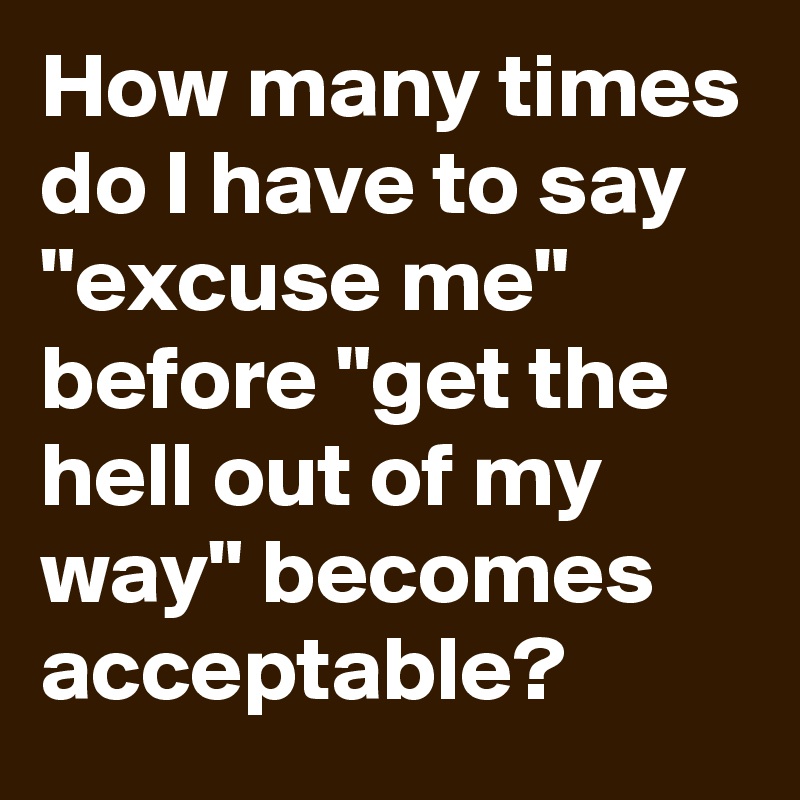 Today, I was struck by such a meme -- one I chose to comment on both of the occasions that it crossed my news feed because it hits so close to home. The meme simply asked how many times one needed to say 'excuse me' to a person before they shouted 'get the hell out of my way.' It's not the meme that bothers me so much, but the mindset that spurred it.
I was astonished at the impertinence of those who commented under the posts, with numerical answers ranging from once is enough to suggesting that ramming the person with their shopping cart was acceptable. People who surely thought they were being amusing. I hope.
I could have scrolled past and ignored it, as I often do. Instead, I decided to comment on both posts that it was never acceptable to do that, not just because it's hateful, but because the person may be deaf or hard-of hearing and might not have heard them. I know it's happened to me many times. I'm only aware of those times because my daughters happened to be with me and nudged me out of the way. I'm certain it happens a lot when I'm alone, too.
The truth is that you don't know if the person is just being rude or if they simply cannot hear you. The presumption that the person is being rude and deserves a crude response is both uncivil and inappropriate. And insensitive. And people need to know that.
Living with hearing loss is no easy task in a world that takes hearing for granted. To presume that others can hear as well as another is an attitude that I hope to correct and change. One person at a time. One comment at a time.
Unfortunately, both of the posts appeared to be taken down after I commented, so my message was lost. Perhaps out of respect for me. Or embarrassment. Or because these friends have a new understanding. Whatever the reason, it is for the good. Two friends will think differently the next time someone doesn't move when they've been asked.
Invisible disabilities are real and prevalent. It's never okay to forget that. We can't assume the motives of others because we don't know why they act the way they do. And we shouldn't be rude because of that ignorance. We should consider the circumstances of others before we react. We should be kinder to one another.
That's what I hope we all learn.
Tuesday, November 21, 2017
Coffee Sign
As I was running errands this morning, I stopped for a coffee at the local Quik Trip. Without even thinking about it, I signed "thank you" to the young man who made my skinny vanilla latte. To my surprise, he signed back. I've no idea what he signed, so I smiled my doofus smile and nodded, grabbed my coffee, and made a quick exit.
 |
| Coffee |
Shortly after I got my cochlear implant, I took a beginning sign language class given by a friend of mine. Learning sign language isn't much different cognitively than learning any language. You have to use and practice it often or you'll forget. Having no one to practice with, I forgot much of the things I learned shortly after the class ended. I used the ASL alphabet in my classroom with my students, finger spelling sight words for spelling practice. I also used a few other signs with them to cut down the noise in my room -- notably the help, restroom, and thank you signs. Those I remember, but other words come slower -- if anyone is willing to wait while I attempt to communicate letter by letter.
I rarely see signing being used in public. Once at a restaurant and another time at the mall. And today by the young latte maker. My daughter is quick to elbow me when we are out together and point out signers when she sees them, as if I am a part of their secret club.
But I'm not much like them at all. We are both deaf, yes. But I don't know their language. And spelling all my words would be woefully tedious for both of us.
My tradition is oral and hearing. I am a hearing person who cannot hear. I have a foot in both worlds.
I wonder how the young man came to sign. Did he learn it because a family member or friend is deaf? Or did he just want to learn it as a second language?
I'll never know because I nearly ran myself over exiting the place. Next time I'll be more prepared.
Wednesday, November 1, 2017
It's Just Not True
I have been asked to speak to a college class of student speech-language pathologists again this year. It has again set my mind thinking about what I can tell these future professionals who will most certainly be working with children and adults who have hearing aids and cochlear implants. I'd like to tell them that the CI is a miracle in hearing technology. I'd like to tell them that hearing with a CI is an amazing experience. But it's just not true.
Sometimes I've been asked by friends to talk to people who are considering implantation. People who want to talk to someone with a CI and ask questions of someone with real-life experience -- not just a hearing doctor or audiologist who's told them they need a CI. Even though implantation is becoming more common, it's still a relatively rare thing, and most people don't know anyone with one. Talking to someone who's gone through it is comforting. I remember how scary and frustrating it was for me. I don't mind doing that. It's always a little weird at first because I'm not like a lot of recipients who sing the praises of the cochlear implant. It just hasn't been as marvelous for me as it seems to be for others. But the people I've met have been appreciative of my candor.
My hard-of-hearing life has become mundanely routine. It begins each morning with me reaching for my hearing aid. I cannot hear well enough without it to function well, so after my eyeglasses, my hearing aid is the 2nd thing I don. But the CI processor often sits in the Zephyr dryer unless I need to go somewhere or hear well while I'm in the house. Like when the hearing hubs wants to have a conversation without me asking him to repeat himself repeatedly. The truth is that I really do hear better with both devices. But it's hardly comfortable, often causing the skin under the magnet to ache, and occasionally leading to headaches, so unless it's necessary for me to hear well, it sits in the dryer until I need it. On days that I do wear it all day, there is a moment each evening where I just can't stand it any longer and I have to take it off.
And all those accessories that go with it? They sit in a box, too. I occasionally charge the remote so I can change my volume if I'm going into an unknown hearing setting. Just in case. But it usually just sits in my purse until the charge runs out and I return it to it's storage box, too. When I use accessories, it's to stream the sound to my hearing aid, not my CI. I hear MUCH better with my hearing aid than my CI.
I'd like to say that after four years with my cochlear implant, that my hearing is so much better now. But I honestly can't say that the quality of sound I perceive is any better than when I first began. I've just gotten used to it. It's still as tinny and mechanical as it's ever been. I don't hold any false hopes that it will improve with listening practice because I've been listening for four years. I still struggle with comprehension. Closed captioning has become a necessity when I watch TV, even when I stream the sound to my hearing aid. Actors have terrible enunciation. They aren't the only ones either. It's difficult to understand a lot of people because of poor and/or lazy speaking habits that blur sounds and words. And there are no closed captions to read during live conversation! I still miss a lot. I have anxiety that if I lose my other ear, the CI won't be sufficient for me to hear or understand well at all.
Cochlear implants are often touted by hearing professionals and recipients as miracle devices full of wonder and awe. It's just not true. It will help you hear. But it will be limited by your own physiology and by it's technological parameters. The struggle is real. And it's continual. And it's exhausting.
This is what you should know.
Sometimes I've been asked by friends to talk to people who are considering implantation. People who want to talk to someone with a CI and ask questions of someone with real-life experience -- not just a hearing doctor or audiologist who's told them they need a CI. Even though implantation is becoming more common, it's still a relatively rare thing, and most people don't know anyone with one. Talking to someone who's gone through it is comforting. I remember how scary and frustrating it was for me. I don't mind doing that. It's always a little weird at first because I'm not like a lot of recipients who sing the praises of the cochlear implant. It just hasn't been as marvelous for me as it seems to be for others. But the people I've met have been appreciative of my candor.
My hard-of-hearing life has become mundanely routine. It begins each morning with me reaching for my hearing aid. I cannot hear well enough without it to function well, so after my eyeglasses, my hearing aid is the 2nd thing I don. But the CI processor often sits in the Zephyr dryer unless I need to go somewhere or hear well while I'm in the house. Like when the hearing hubs wants to have a conversation without me asking him to repeat himself repeatedly. The truth is that I really do hear better with both devices. But it's hardly comfortable, often causing the skin under the magnet to ache, and occasionally leading to headaches, so unless it's necessary for me to hear well, it sits in the dryer until I need it. On days that I do wear it all day, there is a moment each evening where I just can't stand it any longer and I have to take it off.
And all those accessories that go with it? They sit in a box, too. I occasionally charge the remote so I can change my volume if I'm going into an unknown hearing setting. Just in case. But it usually just sits in my purse until the charge runs out and I return it to it's storage box, too. When I use accessories, it's to stream the sound to my hearing aid, not my CI. I hear MUCH better with my hearing aid than my CI.
I'd like to say that after four years with my cochlear implant, that my hearing is so much better now. But I honestly can't say that the quality of sound I perceive is any better than when I first began. I've just gotten used to it. It's still as tinny and mechanical as it's ever been. I don't hold any false hopes that it will improve with listening practice because I've been listening for four years. I still struggle with comprehension. Closed captioning has become a necessity when I watch TV, even when I stream the sound to my hearing aid. Actors have terrible enunciation. They aren't the only ones either. It's difficult to understand a lot of people because of poor and/or lazy speaking habits that blur sounds and words. And there are no closed captions to read during live conversation! I still miss a lot. I have anxiety that if I lose my other ear, the CI won't be sufficient for me to hear or understand well at all.
Cochlear implants are often touted by hearing professionals and recipients as miracle devices full of wonder and awe. It's just not true. It will help you hear. But it will be limited by your own physiology and by it's technological parameters. The struggle is real. And it's continual. And it's exhausting.
This is what you should know.
Saturday, August 26, 2017
I Didn't Forget
August 14 came and went again this year.
I didn't forget that it was the anniversary of my sudden hearing loss.
I didn't forget to make a blog post marking the day that thrust me into muffled silence.
I didn't forget the moment my life changed forever.
I didn't forget the audiogram that determined my level of sound perception in my damaged cochlea.
I didn't forget the doctor's words when he told me my hearing loss was profound. And permanent.
I didn't forget the feeling of panic as I drove home. Fearing the impact deafness would make on my life. The desperation. And the dread.
I didn't forget the confusion and frustration as I tried to come to grips with a life where I couldn't understand conversation, television, radio, or take a simple phone call.
I didn't forget the challenges of learning about speech bananas, audiograms, decibels, hearing aids, batteries, dome tips, volume, wind noise, static, reverberation, feedback, vibrating alarms, strobe notifications, FM assistive listening devices, euro adapters, amplification, closed captioning, hearing impaired settings, ADA, and ear wax. Or cochlear implants.
I didn't forget the missed conversations, the "whats?", and the "never minds."
I didn't forget appointments for CTs and MRIs and balance tests and audiograms and evaluations.
I didn't forget the misunderstanding, impatience, and cruel words of coworkers and administrators - spoken behind my back, but revealed to me by true friends -- as I struggled to cope and adapt.
I didn't forget the friends and family who offered support and empathy -- who lent an ear, directed me to places for help, cried along with me as I grieved.
I didn't forget the doctors and audiologists who expertly and patiently eased me into hearing aids, assistive listening devices, and cochlear implant programs that help me make the best of an imperfect situation.
I didn't forget the ones who repeat their words over and over, make the effort to speak clearly when addressing me, or clip my microphone to their shirt so that I am included in their conversations. And their lives.
I didn't forget the children whose hearing loss I noticed -- and helped. Likely more aware because of my own hearing loss.
I didn't forget the people I've friended who've experienced sudden hearing loss, as well, and the encouraging word I can now offer to them because I know what it's like.
I didn't forget the resilience that hearing loss would force upon me. From utter devastation to coping to surviving to encouraging. To living.
I didn't forget.
Tuesday, July 25, 2017
Time

It's a strange, abstract perception of our being. Both finite and infinite at the same time.
We mark our days by time. Life events. Successes. Failures. Embarrassments. Accomplishments. Our hopes.
Clocks. Calendars. Days, weeks, and minutes. Years. Our remembrances of time.
Current events remind us that we've learned little from our time here. History repeats itself. And wise elders are reminding us to mark this time; to closely pay attention so that our recollections may provide stories and insight for future generations. If they care to know. Or care to heed.
It's a regular handmaid's tale...
This week I am reminded that time affects many things. There's never quite enough of it to do what I've planned, but there's an incredible amount of it to waste.
I retired 67 days ago. 2.2 months. 9 1/2 weeks. 1608 hours. 96,480 minutes. And I've spent 30 minutes of that time ruminating the concept of time to write this blog.
I've been deaf for 5 years. I do not want to know how many months or minutes have passed since then.
Five years is fleeting for growing children and towering trees But it is a very long time to not hear.
Thursday, July 13, 2017
Five Years is a Long Time
I answered a survey about hearing loss today. It was sent to my email inbox by a hearing loss association. I'm pretty sure it was in response to the bill proposed in Washington that will make over-the-counter hearing aids available to anyone who wants them -- those without a doctor's prescription, diagnosis, audiogram, or exam.
While I know there are a great many people in the world with undiagnosed hearing loss -- and many with diagnosed hearing loss who simply cannot afford a hearing aid -- who could benefit from the expected lower cost of over-the-counter hearing aids, I have mixed feelings as to whether this policy is a good idea or not. Selecting, wearing, and benefitting from a hearing aid is complex. Much different than purchasing reading glasses -- a simplistic analogy of the impetus behind the OTC hearing aid movement.
In the five years since I lost my hearing, I've learned a great deal about hearing loss and hearing aids. They can be really great. And they can be really awful, too. Working through an audiologist is surely more beneficial than walking into a Walgreens and selecting a factory pre-programmed hearing aid that may or may not fit comfortably, amplify sounds appropriately, or achieve desirable results.
Five years is a long time to learn about optimizing programs and settings, choosing generic canal tips or custom ear molds, selecting a receiver-in-the-ear vs. behind-the-ear model, consideration of T-coils and Bluetooth, finding and using compatible assistive listening devices, learning to care for and maintain your devices, seeking adjustments and reprogramming to meet ongoing hearing changes and needs...
Five years is a long time to learn that you get what you pay for. I've upgraded my hearing aids twice to improve the quality of hearing. My first "basic" pair was terrible, at best. Hardly worth using. I worry that these mass-produced hearing aids will be of such poor quality that people's experiences with them will discourage them from seeking audiological evaluations and more advanced devices when and if their hearing warrants it. And with the availability of these "cheaper" hearing aids, will insurance companies like mine discontinue coverage of more sophisticated devices necessary for those of us who have more profound hearing loss and send us to the corner drugstore for help, too?
Five years is a long time to work with an audiologist to maximize my hearing success through initial diagnosis, routine monitoring and adjustments, counseling, and guidance towards success. My audiologist can be credited with the majority of my success with my hearing devices. I am dependent on her expertise. I don't think a drugstore clerk could hold a candle to her.
It's far more complex than selecting a cute red or blue one to help you hear better. And like myself, I seriously doubt most people will have any idea about what hearing aids would be best for their unique hearing needs or how to use them properly without an exam and diagnosis.
It will be interesting to see how this pans out.
While I know there are a great many people in the world with undiagnosed hearing loss -- and many with diagnosed hearing loss who simply cannot afford a hearing aid -- who could benefit from the expected lower cost of over-the-counter hearing aids, I have mixed feelings as to whether this policy is a good idea or not. Selecting, wearing, and benefitting from a hearing aid is complex. Much different than purchasing reading glasses -- a simplistic analogy of the impetus behind the OTC hearing aid movement.
In the five years since I lost my hearing, I've learned a great deal about hearing loss and hearing aids. They can be really great. And they can be really awful, too. Working through an audiologist is surely more beneficial than walking into a Walgreens and selecting a factory pre-programmed hearing aid that may or may not fit comfortably, amplify sounds appropriately, or achieve desirable results.
Five years is a long time to learn about optimizing programs and settings, choosing generic canal tips or custom ear molds, selecting a receiver-in-the-ear vs. behind-the-ear model, consideration of T-coils and Bluetooth, finding and using compatible assistive listening devices, learning to care for and maintain your devices, seeking adjustments and reprogramming to meet ongoing hearing changes and needs...
Five years is a long time to learn that you get what you pay for. I've upgraded my hearing aids twice to improve the quality of hearing. My first "basic" pair was terrible, at best. Hardly worth using. I worry that these mass-produced hearing aids will be of such poor quality that people's experiences with them will discourage them from seeking audiological evaluations and more advanced devices when and if their hearing warrants it. And with the availability of these "cheaper" hearing aids, will insurance companies like mine discontinue coverage of more sophisticated devices necessary for those of us who have more profound hearing loss and send us to the corner drugstore for help, too?
Five years is a long time to work with an audiologist to maximize my hearing success through initial diagnosis, routine monitoring and adjustments, counseling, and guidance towards success. My audiologist can be credited with the majority of my success with my hearing devices. I am dependent on her expertise. I don't think a drugstore clerk could hold a candle to her.
It's far more complex than selecting a cute red or blue one to help you hear better. And like myself, I seriously doubt most people will have any idea about what hearing aids would be best for their unique hearing needs or how to use them properly without an exam and diagnosis.
It will be interesting to see how this pans out.
Monday, June 26, 2017
Thank You, Thank You, A Thousand Times Thank You
Some days, I go without my cochlear implant processor, especially on days when I'm staying around the house and there's no real need for me to hear anything. Days like today. It gives my skin a chance to rest from being pulled by the magnet and gives me a semblance of peace and quiet for a little while.
I'd planned on working in the house, cleaning and de-cluttering years of neglect (and a little bit of laziness) after exhausting days of teaching little ones. So the CI remained in the dry and store box this morning.
I thought of retrieving it for a quick run to the store to get more vinegar for the window cleaning solution, but decided it probably wasn't necessary for such a quick errand -- in and out. Get the vinegar and go. You know, just a few minutes in the store. And I had my hearing aid in, so I wasn't completely deaf.
What I failed to take into consideration was that this particular store was a Target. And there is no such thing as a quick run to Target. (You know I'm right!)
The first problem I encountered was being unable to locate the vinegar. Though I'd walked up the condiments aisle a couple of times, my eyes seemed locked at eye-level, and I didn't see the vinegar nestled on the bottom shelf. I had to ask a young man who was stocking shelves.
Now, I 'm only a fair lip reader, and after the second (maybe third), "Where?", the young man proceeded to walk me to the same aisle from whence I'd come and helped me find the vinegar. I politely thanked him for helping and he went back to work.
But I wasn't done yet. I decided to get a new microfiber cloth.
I headed to the automotive aisle and found the cloths among the car washing supplies. But as each cloth has a specific purpose, I had to read several labels to determine which one was a general purpose cloth for my purpose. I must have dallied in the aisle a little too long. I was greeted by not one or two, but THREE salespeople. I've no idea what they said, but I replied with a generic, "Thank you, I'm fine" to each one. I'm pretty certain that stupid "doofus smile" crossed my face at least once.
And since I was in the area, I browsed the towels. I was thinking of getting another hand towel for my powder room. I was greeted by a young lady restocking the aisle and just as another "Thank you" was rolling across my lips, I turned to see she was actually helping another customer. So I picked up my towel and hurried away before she could talk to me, too.
At the checkout, the young lady engaged me in some kind of conversation, smiling and pleasantly talking as she rang my items -- mostly looking away at the register. She may or may not have asked if I wanted to apply for a red card, as they always do. I decided against speaking and just smiled pleasantly back. I think I thanked her several times, too.
Then on my way out, of course, I had to have a Starbucks. I ordered my drink and could hear the cheerful barista talking as she prepared my frappuccino -- blender and all. I busied myself with counting enough quarters to pay for my drink. It seemed she didn't need a response from me, but I thanked her, anyway.
It seemed appropriate.
Today's excursion was a glaring reminder that no matter what I wish, my hearing aid alone is grossly inefficient. I need to have both of my hearing devices to navigate the hearing world successfully. And without embarrassment. One is not as good as both.
I am extremely fortunate to have a cochlear implant and my decision to be implanted was a good one. Together with my hearing aid, the CI helps me to live a relatively "normal" life. And I am reminded today to be grateful, even when I struggle. And that, friends, is worth a thousand "Thanks".
I'd planned on working in the house, cleaning and de-cluttering years of neglect (and a little bit of laziness) after exhausting days of teaching little ones. So the CI remained in the dry and store box this morning.
I thought of retrieving it for a quick run to the store to get more vinegar for the window cleaning solution, but decided it probably wasn't necessary for such a quick errand -- in and out. Get the vinegar and go. You know, just a few minutes in the store. And I had my hearing aid in, so I wasn't completely deaf.
What I failed to take into consideration was that this particular store was a Target. And there is no such thing as a quick run to Target. (You know I'm right!)
The first problem I encountered was being unable to locate the vinegar. Though I'd walked up the condiments aisle a couple of times, my eyes seemed locked at eye-level, and I didn't see the vinegar nestled on the bottom shelf. I had to ask a young man who was stocking shelves.
Now, I 'm only a fair lip reader, and after the second (maybe third), "Where?", the young man proceeded to walk me to the same aisle from whence I'd come and helped me find the vinegar. I politely thanked him for helping and he went back to work.
But I wasn't done yet. I decided to get a new microfiber cloth.
I headed to the automotive aisle and found the cloths among the car washing supplies. But as each cloth has a specific purpose, I had to read several labels to determine which one was a general purpose cloth for my purpose. I must have dallied in the aisle a little too long. I was greeted by not one or two, but THREE salespeople. I've no idea what they said, but I replied with a generic, "Thank you, I'm fine" to each one. I'm pretty certain that stupid "doofus smile" crossed my face at least once.
And since I was in the area, I browsed the towels. I was thinking of getting another hand towel for my powder room. I was greeted by a young lady restocking the aisle and just as another "Thank you" was rolling across my lips, I turned to see she was actually helping another customer. So I picked up my towel and hurried away before she could talk to me, too.
At the checkout, the young lady engaged me in some kind of conversation, smiling and pleasantly talking as she rang my items -- mostly looking away at the register. She may or may not have asked if I wanted to apply for a red card, as they always do. I decided against speaking and just smiled pleasantly back. I think I thanked her several times, too.
Then on my way out, of course, I had to have a Starbucks. I ordered my drink and could hear the cheerful barista talking as she prepared my frappuccino -- blender and all. I busied myself with counting enough quarters to pay for my drink. It seemed she didn't need a response from me, but I thanked her, anyway.
It seemed appropriate.
Today's excursion was a glaring reminder that no matter what I wish, my hearing aid alone is grossly inefficient. I need to have both of my hearing devices to navigate the hearing world successfully. And without embarrassment. One is not as good as both.
I am extremely fortunate to have a cochlear implant and my decision to be implanted was a good one. Together with my hearing aid, the CI helps me to live a relatively "normal" life. And I am reminded today to be grateful, even when I struggle. And that, friends, is worth a thousand "Thanks".
Wednesday, May 31, 2017
I'm Mad, too, Eddie!
Today I am straying from my deaf life and posting about a different concern.
Three weeks ago, I began to have significant chest pain and shortness of breath. It began suddenly in the night and continued to worsen the next morning. I didn't feel like it was a major concern and went to work the next day. However, by mid-morning, my breathing worsened and I began to feel faint and dizzy. Since both my primary care physician and my cardiologist offices were closed, I had no other option but to go to the ER where I was admitted for observation and tests.
Having a history of dysrhythmia and pulmonary embolism, I was given the standard course of tests -- x-ray, echogram, and stress test, all of which came back normal. It wasn't my heart. Yet the chest pain and shortness of breath continued. At the end of the 2nd day, I was conferring with the hospitalist's PA about my orders to follow up with my primary care physician.
"So, what should I do about the pain and breathlessness until then?" I asked.
"I can give you something for anxiety," she said.
"Why anxiety?" I asked. "Do you think this a panic attack or something?"
"Well, it can relieve your stress and make you feel better," she said.
"I'm stressed because I can't breathe, and you want to give me a pill for anxiety?"
"No. That's not what I'm saying. But maybe it will make you feel better," she went on.
"Because it will...?" I was leading...
"Let me talk to the doctor about what we should do," she said and left my room.
As I lay there in the bed, waiting for someone -- anyone -- to give me answers and relieve my symptoms, I tried to quell the anger that was rising in me. And I remembered.
A gastrointerologist once suggested I see a psychiatrist after I'd been vomiting for 35 days and he deemed there was nothing physically wrong with me. It must be in my head. My private doctor looked at my test results and found that my gallbladder was infected and full of sludge and stones. He overrode the GI's orders and sent a surgeon to my hospital room. Surgery was performed the next morning and I haven't vomited since. The delay in treatment, however, left me with a resulting hiatal hernia from the vomiting and subsequent gastrointestinal problems that will plague me for the rest of my life.
The ire. The gall. The incompetence. The insinuation. I am not a crazy, hysterical, hypochondriac woman. Sometimes I have pain. And when I seek medical attention for it, it's because it's real. It is not in my head.
Yep. You know what? My name is Bonnie, and I'm mad as hell.
I'm mad because too many doctors' go-to diagnosis for women is "anxiety". I'm mad because it's not just me. I'm mad because I hear the same story from other women. Often. I'm mad because we are not hysterical. We are not crazy. I'm mad because anxiety and hysterics still play into the medical treatment for women in this day and age. I'm mad because women deserve better than "I can give you a pill for anxiety."
Would this have happened to a man, I wonder?
"Sir, maybe you should take this pill for anxiety and calm down. This pain is in your head."
I think not. This is the archaic misogyny that is still present in medical practice today. And that makes me mad, too, Eddie.
The conclusion to this drama is that I refused to be told that the pain was in my head. I continued to press my own doctor until I got an answer. Pleurisy and resulting costochondritis. He's now treating me for both the pleurisy and the arthritic pain in the joints connecting the rib cage to the sternum caused by the pleurisy. I thanked him for treating me with respect and dignity. For persisting until he found the correct cause of my pain. For not insinuating that I am just a hysterical woman.
I feel a little better now that I have a treatment plan for my symptoms. Symptoms that can be treated and relieved. Symptoms that are real.
But I'm still mad. Oh yeah. Is there a pill for that?
Three weeks ago, I began to have significant chest pain and shortness of breath. It began suddenly in the night and continued to worsen the next morning. I didn't feel like it was a major concern and went to work the next day. However, by mid-morning, my breathing worsened and I began to feel faint and dizzy. Since both my primary care physician and my cardiologist offices were closed, I had no other option but to go to the ER where I was admitted for observation and tests.
Having a history of dysrhythmia and pulmonary embolism, I was given the standard course of tests -- x-ray, echogram, and stress test, all of which came back normal. It wasn't my heart. Yet the chest pain and shortness of breath continued. At the end of the 2nd day, I was conferring with the hospitalist's PA about my orders to follow up with my primary care physician.
"So, what should I do about the pain and breathlessness until then?" I asked.
"I can give you something for anxiety," she said.
"Why anxiety?" I asked. "Do you think this a panic attack or something?"
"Well, it can relieve your stress and make you feel better," she said.
"I'm stressed because I can't breathe, and you want to give me a pill for anxiety?"
"No. That's not what I'm saying. But maybe it will make you feel better," she went on.
"Because it will...?" I was leading...
"Let me talk to the doctor about what we should do," she said and left my room.
As I lay there in the bed, waiting for someone -- anyone -- to give me answers and relieve my symptoms, I tried to quell the anger that was rising in me. And I remembered.
A gastrointerologist once suggested I see a psychiatrist after I'd been vomiting for 35 days and he deemed there was nothing physically wrong with me. It must be in my head. My private doctor looked at my test results and found that my gallbladder was infected and full of sludge and stones. He overrode the GI's orders and sent a surgeon to my hospital room. Surgery was performed the next morning and I haven't vomited since. The delay in treatment, however, left me with a resulting hiatal hernia from the vomiting and subsequent gastrointestinal problems that will plague me for the rest of my life.
The ire. The gall. The incompetence. The insinuation. I am not a crazy, hysterical, hypochondriac woman. Sometimes I have pain. And when I seek medical attention for it, it's because it's real. It is not in my head.
Yep. You know what? My name is Bonnie, and I'm mad as hell.
I'm mad because too many doctors' go-to diagnosis for women is "anxiety". I'm mad because it's not just me. I'm mad because I hear the same story from other women. Often. I'm mad because we are not hysterical. We are not crazy. I'm mad because anxiety and hysterics still play into the medical treatment for women in this day and age. I'm mad because women deserve better than "I can give you a pill for anxiety."
Would this have happened to a man, I wonder?
"Sir, maybe you should take this pill for anxiety and calm down. This pain is in your head."
I think not. This is the archaic misogyny that is still present in medical practice today. And that makes me mad, too, Eddie.
The conclusion to this drama is that I refused to be told that the pain was in my head. I continued to press my own doctor until I got an answer. Pleurisy and resulting costochondritis. He's now treating me for both the pleurisy and the arthritic pain in the joints connecting the rib cage to the sternum caused by the pleurisy. I thanked him for treating me with respect and dignity. For persisting until he found the correct cause of my pain. For not insinuating that I am just a hysterical woman.
I feel a little better now that I have a treatment plan for my symptoms. Symptoms that can be treated and relieved. Symptoms that are real.
But I'm still mad. Oh yeah. Is there a pill for that?
Subscribe to:
Posts (Atom)